

𝒮𝓇𝒾𝓁𝒶 ℬ𝒽𝒶𝓀𝓉𝒾 𝒩𝒾𝓈𝓀𝒶𝓂𝒶 𝒮𝒽𝒶𝓃𝓉𝒶 ℳ𝒶𝒽𝒶𝓇𝒶𝒿, 𝒫𝒽.𝒟.
𝖲𝖾𝗏𝖺𝗂𝗍-𝖯𝗋𝖾𝗌𝗂𝖽𝖾𝗇𝗍-𝖠𝖼𝗁𝖺𝗋𝗒𝖺, 𝖲𝗋𝗂 𝖢𝗁𝖺𝗂𝗍𝖺𝗇𝗒𝖺 𝖲𝖺𝗋𝖺𝗌𝗐𝖺𝗍 𝖬𝖺𝗍𝗁
𝖭𝗋𝗂𝗌𝗂𝗇𝗀𝗁𝖺 𝖯𝖺𝗅𝗅𝗂, 𝖭𝖺𝖻𝖺𝖽𝗐𝗂𝗉 𝖣𝗁𝖺𝗆, 𝖶𝖾𝗌𝗍 𝖡𝖾𝗇𝗀𝖺𝗅, 𝖨𝗇𝖽𝗂𝖺
📲 𝐒𝐭𝐚𝐲 𝐔𝐩𝐝𝐚𝐭𝐞𝐝 𝐨𝐧 𝐖𝐡𝐚𝐭𝐬𝐀𝐩𝐩 𝐂𝐡𝐚𝐧𝐧𝐞𝐥
The contemporary attempt to formalise spiritual care through structured “counselor systems” presents itself as a compassionate and necessary evolution within devotional society. It arises from a genuine concern: devotees feel neglected, unsupported, and often spiritually isolated despite being part of a theological tradition that proclaims the highest form of divine love. In response, an organised mechanism is proposed—delegating responsibility to trained individuals who provide guidance, emotional support, and practical direction in the lives of practitioners. At a superficial level, this appears not only beneficial but urgently required.
Yet, when examined through the lens of Gauḍīya Vaiṣṇava siddhānta, particularly as illuminated by Śrīla Bhakti Rakṣak Śrīdhar Dev-Goswāmī Mahārāj, a profound ontological tension emerges. The issue is not whether devotees should care for one another—this is unquestionably essential—but whether such care can be systematised in a way that preserves the integrity of śikṣā-Guru-tattva, or whether it inadvertently replaces transcendental descent with institutional mediation.
The root of the problem lies in a subtle but critical redefinition. In the counselor paradigm, śikṣā is treated primarily as instructional activity—whoever instructs, guides, or advises is, by functional extension, considered a śikṣā-Guru. This interpretation, while appealing in its inclusivity, represents a fundamental departure from Gauḍīya ontology. Śikṣā, in its true sense, is not merely the transmission of information, nor even the application of philosophy to daily life. It is the descent of realised truth, a living current flowing through a transparent medium who is internally connected to the plane of divine service.
Śrīla Śrīdhar Mahārāj repeatedly warned that Guru is not to be reduced to personality or position. Guru is the current of divine will descending from the higher plane. One who participates in that current may externally appear as a speaker, teacher, or guide, but the defining characteristic is not the function of instruction—it is realisation and ontological connection. Without that connection, instruction remains within the realm of mental adjustment, not spiritual transformation.
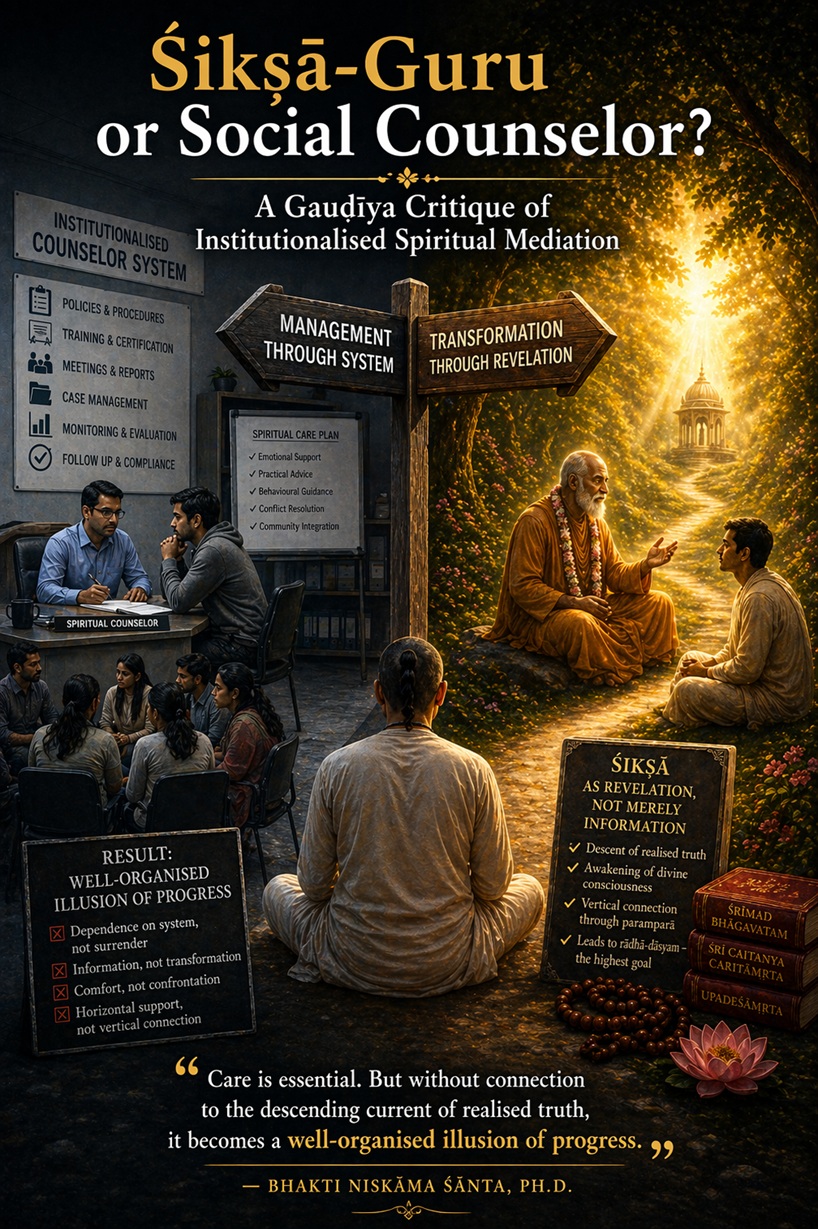
The counselor system, however, operates predominantly within the domain of horizontal exchange. It emphasises peer-based guidance, structured interaction, regular meetings, behavioural refinement, and psychological support. These are valuable elements within a social framework, but they belong to the plane of relative organisation, not to the domain of transcendental revelation. When such structures begin to assume the role of primary spiritual guidance, a gradual but decisive shift occurs: the devotee’s dependence moves from the vertical axis of paramparā to the horizontal network of mundane community.
This shift is subtle, and therefore dangerous. It does not immediately negate devotion; rather, it reorients its centre of gravity. The practitioner begins to seek clarity not from the depth of realised śikṣā, but from the accessibility of available counsel. Spiritual life becomes navigated through discussion, consensus, and managed advice rather than through surrender to higher, and often uncomfortable, revelation. In this way, transcendence is gently replaced by manageability.
The philosophical implications of this transition are significant. Gauḍīya Vaiṣṇavism is not a system of behavioural perfection; it is a path of inner ontological transformation, culminating in rādhā-dāsyam—the highest plane of divine service characterised by total self-forgetfulness in love. Such transformation cannot be engineered through social systems, however refined. It arises only through contact with that plane which already embodies it. The role of śikṣā-Guru, therefore, is not to organise life within the material plane, but to interrupt it, to introduce a current that destabilises egoic identity and redirects consciousness toward the Absolute.
By contrast, the counselor model tends toward stabilisation rather than disruption. It seeks to help the individual function better—within family, society, and devotional structure. It addresses problems, resolves conflicts, and provides continuity. While these are necessary at a certain level, they risk confining spiritual life within the boundaries of well-adjusted material existence. A devotee may become balanced, socially integrated, and emotionally supported, yet remain untouched by the radical demand of divine love.
Śrīla Śrīdhar Mahārāj cautioned that when the Absolute is approached through organisation alone (society consciousness), it becomes obscured. Organisation is not rejected, but it must remain subordinate to revelation (God Consciousness). When it assumes primacy, it begins to imitate the functions of the higher plane without possessing its substance. This imitation is particularly evident in the appropriation of the term “śikṣā-Guru” for individuals whose qualification is primarily managerial or relational. The danger here is not merely semantic; it is theological. When the term is diluted, the conception it represents is also diminished.
The frequent citation of Śrīla A.C. Bhaktivedānta Swāmī Mahārāj Prabhupāda’s statement that “a śikṣā-Guru is as good as the dīkṣā-Guru” further illustrates this misapplication. This statement presupposes that the śikṣā-Guru is situated within the same current of realised truth as the dīkṣā-Guru. It does not equate all instructors with spiritual authority, nor does it endorse the multiplication of Guru-tattva through functional designation. To interpret it otherwise is to collapse the distinction between transcendental agency and pedagogical assistance.
The sociological success of the counselor system—its ability to retain members, create cohesion, and generate enthusiasm—cannot be denied. However, Gauḍīya tradition does not evaluate success through numerical growth or institutional stability. Its measure is internal: the awakening of genuine taste for the Holy Name, the deepening of humility, and the emergence of selfless service mood. These are not the products of systematic training alone; they are the byproducts of living contact with realised truth.
It is therefore necessary to distinguish between care and conception. Care is indispensable, but it must be guided by correct conception. Without that, care itself can become a vehicle for deviation. A society that provides extensive support but lacks depth of realisation may produce devotees who are loyal, engaged, and satisfied, yet spiritually stagnant. They remain within the system, but do not progress toward the ultimate spiritual goal.
The deeper tragedy is that such a system may appear successful precisely because it prevents the symptoms of failure. Devotees do not leave; they are comfortable. Conflicts are managed; dissatisfaction is addressed. But the absence of crisis does not necessarily indicate the presence of growth. In many cases, it signals the absence of confrontation with the mundane current.
Śrī Caitanya Mahāprabhu’s own example is often invoked to support models of service and care, yet His method was fundamentally different. He did not establish systems of counseling; He ignited hearts. His association was transformative not because it addressed practical needs, but because it revealed the highest plane of divine love. His service to devotees was not managerial—it was existential, arising from His own position as the embodiment of prema. To imitate His external acts without access to His internal state is to reduce līlā to social ethics.
This does not imply that structured care should be abandoned. Rather, it must be recontextualised. Devotees may assist one another, guide each other in practical matters, and provide emotional support. But such roles must never be conflated with śikṣā-Guru-tattva. The latter remains a matter of recognition, not appointment; of descent, not designation.
A healthy devotional society must preserve the primacy of the vertical current. All horizontal arrangements must serve to facilitate, not replace, that connection. When seekers are guided to take shelter in genuinely realised authority—even when such association is rare and not immediately accessible—the integrity of the spiritual current remains intact, preserving both direction and depth. But when that sacred ideal is replaced by expedient substitutes—such as GBC-chosen Gurus or the appointment of unqualified persons as Gurus under the influence of foreign money and institutional politics—the very axis of guidance becomes distorted. However well-intentioned such systems may appear, they risk obscuring the path, replacing realisation with designation, and gradually veiling the living current of truth beneath layers of formality and power structures. In doing so, Guru-paramparā is reduced to a system engineered by human beings, rather than recognised as a divine descent, effectively sidelining the active, sovereign role of the Supreme in revealing and establishing true spiritual authority.
In the final analysis, the question is not whether the counselor system works at a social level—it clearly does. The question is whether it preserves the essential nature of Gauḍīya Vaiṣṇavism as a path of descending revelation leading to transcendental love. If it does not, then its success becomes part of the problem.
For Gauḍīya siddhānta does not aim merely to create a harmonious society of devotees. It aims to awaken the soul to its eternal function in the service of Śrīmatī Rādhārāṇī. Any system that does not actively serve that end, however efficient or compassionate, must be carefully examined. Otherwise, in the name of care, we may gradually replace the living current of divine truth with a well-organised reflection of it—functional, stable, and reassuring, yet ultimately disconnected from the very source it seeks to represent.

Discover more from The Rūpa–Saraswatī Current
Subscribe to get the latest posts sent to your email.
