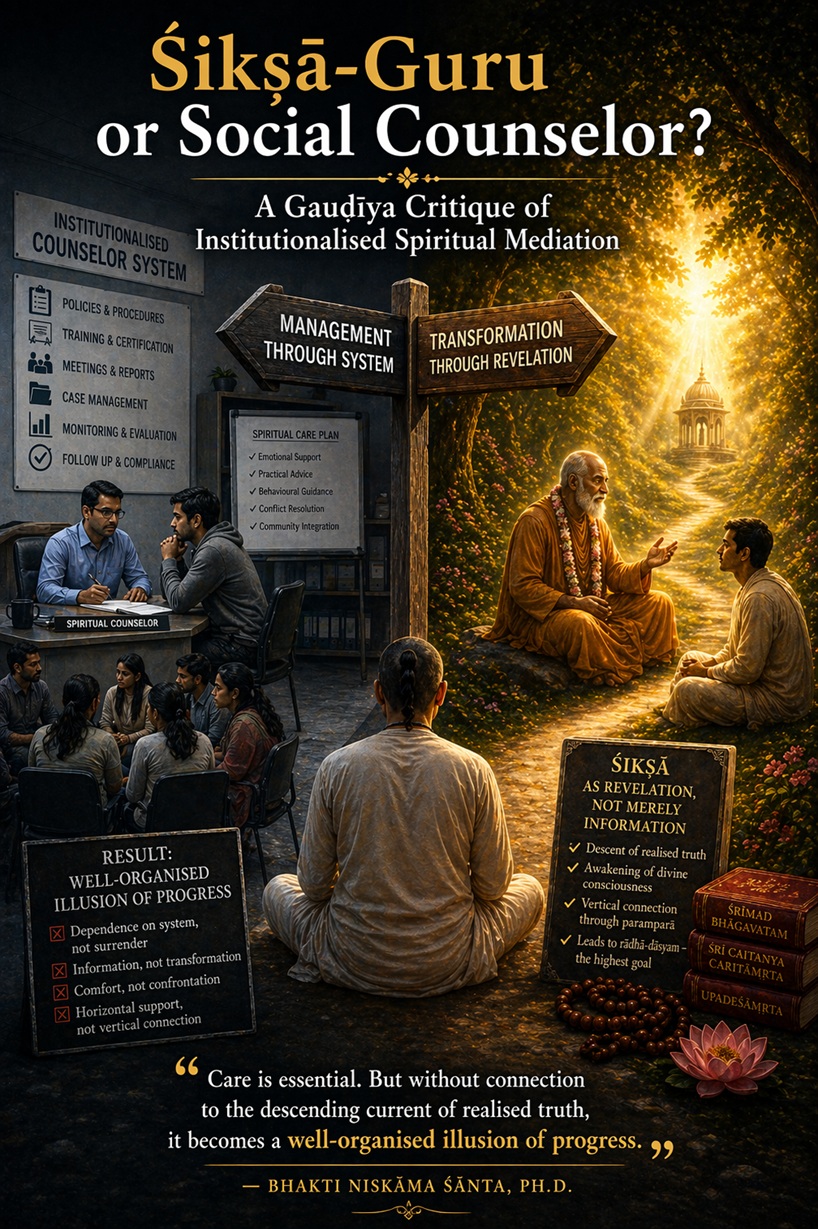


🌸 Śikṣā-Guru: Between Instruction and Revelation — A Gauḍīya Reassessment 🌸
𝒮𝓇𝒾𝓁𝒶 ℬ𝒽𝒶𝓀𝓉𝒾 𝒩𝒾𝓈𝓀𝒶𝓂𝒶 𝒮𝒽𝒶𝓃𝓉𝒶 ℳ𝒶𝒽𝒶𝓇𝒶𝒿, 𝒫𝒽.𝒟.
𝖲𝖾𝗏𝖺𝗂𝗍-𝖯𝗋𝖾𝗌𝗂𝖽𝖾𝗇𝗍-𝖠𝖼𝗁𝖺𝗋𝗒𝖺, 𝖲𝗋𝗂 𝖢𝗁𝖺𝗂𝗍𝖺𝗇𝗒𝖺 𝖲𝖺𝗋𝖺𝗌𝗐𝖺𝗍 𝖬𝖺𝗍𝗁
𝖭𝗋𝗂𝗌𝗂𝗇𝗀𝗁𝖺 𝖯𝖺𝗅𝗅𝗂, 𝖭𝖺𝖻𝖺𝖽𝗐𝗂𝗉 𝖣𝗁𝖺𝗆, 𝖶𝖾𝗌𝗍 𝖡𝖾𝗇𝗀𝖺𝗅, 𝖨𝗇𝖽𝗂𝖺
📲 𝐒𝐭𝐚𝐲 𝐔𝐩𝐝𝐚𝐭𝐞𝐝 𝐨𝐧 𝐖𝐡𝐚𝐭𝐬𝐀𝐩𝐩 𝐂𝐡𝐚𝐧𝐧𝐞𝐥
In the contemporary devotional landscape, one often encounters an expanded and seemingly inclusive understanding of the term śikṣā-Guru. It is commonly said that anyone who offers guidance in spiritual life—who advises on chanting, service, or daily conduct—may be regarded as a śikṣā-Guru. At first glance, this appears both practical and compassionate, especially in a growing devotional community where guidance is necessary at many levels. Yet, beneath this seemingly benign expansion lies a profound philosophical concern. The Gauḍīya tradition does not deny the importance of instruction, but it draws a clear and essential distinction between instruction as information and instruction as revelation.
Śrīla A.C. Bhaktivedānta Swāmī Mahārāj Prabhupāda has indeed stated that a śikṣā-Guru is as good as a dīkṣā-Guru, as he gives instruction in the science of devotional service. However, this statement must be understood in its proper ontological context. “As good as” does not imply that the position is easily assumed or functionally distributed. Rather, it indicates that both are manifestations of the same divine principle—Guru-tattva—which descends from the plane of absolute reality to guide the conditioned soul. The equality is qualitative, not administrative. It is rooted in realisation, not in role.
The difficulty arises when this ontological depth is replaced by a functional approximation. When instruction alone becomes the criterion, the term śikṣā-Guru risks being reduced to a designation for those who offer guidance, irrespective of their inner realisation. But the Gauḍīya understanding of Guru cannot be confined to the transmission of conceptual knowledge. Guru is not merely one who speaks about Absolute Truth; he is one through whom Absolute Truth speaks. As Śrīla Bhakti Rakṣak Śrīdhar Dev-Goswāmī Mahārāj has expressed with characteristic precision, the Guru is the transparent medium of the divine will. This transparency is not a matter of training or appointment; it is the fruit of deep spiritual realisation.
One may draw a parallel from the scientific domain. There is a meaningful distinction between one who teaches a theory and one who has realised its implications through discovery. A lecturer may explain the principles of physics with clarity, but only one who has penetrated its deeper layers through insight can truly guide others into its living reality. Similarly, in spiritual life, one may repeat scriptural teachings accurately, yet without realisation, such repetition does not carry the transformative potency that awakens consciousness. The function of the śikṣā-Guru is not merely to inform but to illuminate—to bring about a qualitative shift in the inner life of the aspirant.
The Gauḍīya tradition is fundamentally based on the principle of descent, where the covering of ignorance is removed by the intervention of higher reality. This is not achieved through organisation or systematisation, but through living contact with one who stands connected to that higher plane. Śrī Caitanya-caritāmṛta affirms that the guru is a manifestation of Kṛṣṇa Himself, appearing to guide the jīva. This manifestation cannot be manufactured, nor can it be universally distributed by necessity. It is recognised through its effect: the awakening of genuine spiritual aspiration, the softening of the heart, and the emergence of a higher taste.
In the absence of this descending current, spiritual guidance tends to shift subtly toward management. Devotees may be guided, organised, and supported, but the emphasis gradually moves from transformation of consciousness to regulation of behaviour. Service becomes structured around roles and responsibilities, and spiritual growth is measured by consistency and conformity. While these have their place, they do not constitute the essence of Gauḍīya conception. The jīva is not meant to become a well-adjusted participant in a system; he is meant to awaken to his eternal identity as a servant of Kṛṣṇa.
This awakening reaches its fullest expression in the conception of Rādhā-dāsyam, the service of Śrīmatī Rādhārāṇī, which stands as the highest ideal in the Gauḍīya tradition. The role of the genuine śikṣā-Guru is to gradually orient the disciple toward this plane, not merely to maintain him within the boundaries of regulated practice. Without this direction, spiritual life risks remaining confined to its preliminary stages. One may become disciplined, informed, and even externally devoted, yet remain distant from the inner current of divine love.
It is also necessary to recognise that much of what is termed guidance today operates within a psychological framework. Emotional support, personal counselling, and practical advice are undoubtedly valuable, especially in the early stages of devotional life. However, these operate primarily on the level of the mind. They may stabilise the practitioner, but they do not, in themselves, awaken transcendental consciousness. The transformation sought in bhakti is not merely behavioural or emotional; it is ontological. It involves a reorientation of the very identity of the self, from the centre of ego to the centre of divine service.
When such psychological functions are conflated with the role of śikṣā-Guru, a subtle substitution takes place. The devotee may begin to relate to the guide as an authority in spiritual life, even though the relationship is not grounded in realised transmission. This can lead to a form of dependence that is not spiritually fruitful. The true Guru does not create dependence on himself as a person; he awakens dependence on Kṛṣṇa and attraction to the divine plane. His presence does not centralise authority—it dissolves it into service.
The Gauḍīya tradition certainly accommodates a plurality of instructors. There is ample room for teachers, mentors, and well-wishers who assist others in their practice. Such service is invaluable and should be encouraged. Yet, to equate all such roles with that of śikṣā-Guru is to blur a critical distinction. Not every instructor is a Guru, just as not every speaker of philosophy is a realised soul. The honour of the term Guru must be preserved in its depth, lest it lose its transformative significance.
The proper harmony lies in recognising gradation without diminishing service. Those who guide others in practical matters perform an essential function within the devotional community. But the śikṣā-Guru, in the true Gauḍīya sense, is one who carries within himself the living current of divine realisation and is capable of awakening that same current in others. His words are not merely instructive; they generate spiritual consciousness. They do not simply clarify the path—they draw the soul forward along it.
In this light, the question is not whether many can instruct, but whether instruction alone constitutes the essence of Guru-tattva. The answer, as given by the Āchāryas, is clear. Guru is not defined by the act of teaching, but by the presence of realised truth. Where that presence is found, instruction becomes revelation; where it is absent, words become hollow and cannot awaken realisation.
Thus, a sincere practitioner must cultivate discernment—not in a spirit of criticism, but in a spirit of aspiration. One should gratefully accept guidance wherever it is helpful, yet remain inwardly oriented toward that higher association which awakens genuine spiritual life. For in the final analysis, the journey of bhakti is not sustained by structure, but by substance; not by designation, but by realisation.
And it is only through contact with such realised guidance that the heart is truly transformed, and the soul is drawn, step by step, toward its eternal home in the service of Śrī Śrī Rādhā-Govinda.

Discover more from The Rūpa–Saraswatī Current
Subscribe to get the latest posts sent to your email.