


source: click here
Dear Professor Fitch,
Thank you for your thoughtful response and engagement with my message. I appreciate the intellectual openness with which you addressed a topic that often generates more heat than light.
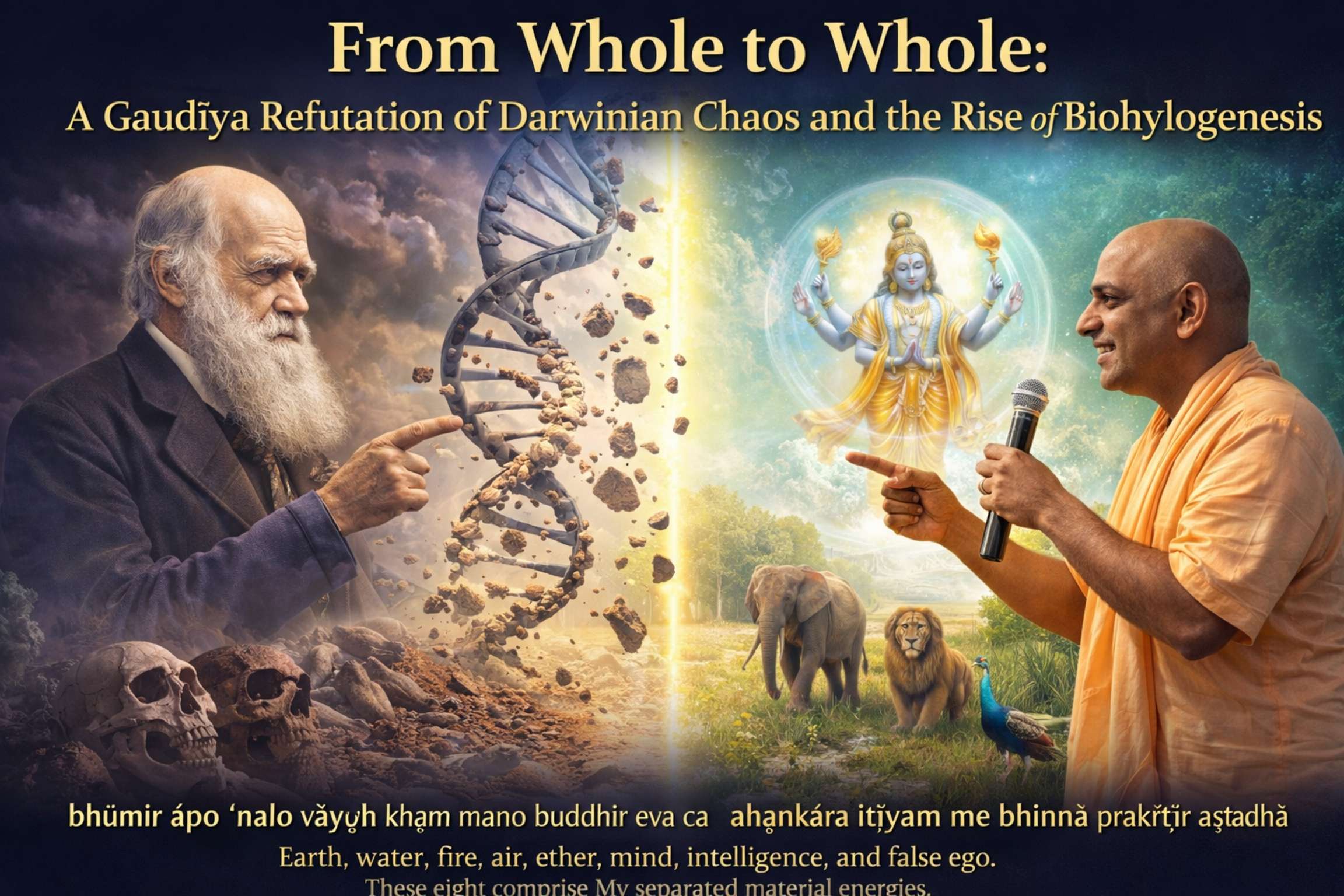
Your reply makes several important distinctions—particularly between Darwinian evolution and materialistic reductionism, between randomness and natural selection, and between scientific inquiry and philosophical misappropriation. These are welcome clarifications. Yet I believe that the heart of the disagreement lies not in scientific data, but in ontological commitments. I would like to address further concerns regarding the foundational assumptions within Darwinian theory, particularly as it has evolved into the modern synthesis of evolutionary biology. These concerns are not rhetorical but philosophical, linguistic, and scientific—touching upon the ontology of life, the nature of individuality, and the limits of population-level models in capturing the essence of living beings.
Allow me, therefore, to respectfully respond point by point and clarify my position.
1.On Evolution as a Straw Man
The term “selection,” central to Darwinian theory, is semantically and philosophically problematic. To “select” implies a subject capable of choice—an entity with agency, discernment, and intentionality. In Darwin’s own writings, “natural selection” served as a metaphor, likening nature to a breeder or selector—thus subtly personifying an otherwise blind, impersonal process.
Yet this metaphor has misled generations into believing that a coherent, directional force operates within biological evolution. In reality, there is no subject that selects—only differential survival and reproduction shaped by environmental contingencies and inherited variation. Still, the language of “selection” persists, covertly importing the semantics of subjectivity into a theory that denies the presence of any subject—no soul, no self, no mind.
This contradiction is not merely linguistic—it is ontological and philosophical. Evolutionary theory adopts the language of agency while denying the metaphysical reality of agency. From a Vedāntic perspective, this renders the framework internally inconsistent and conceptually incoherent.
Furthermore, modern biology increasingly defines life in population-level terms, systematically marginalizing the individual. Evolution, behavior, and even morality are interpreted as emergent properties of statistical aggregates: gene frequencies, fitness landscapes, and reproductive success. Yet this approach overlooks the most essential feature of life: the conscious individuality of living beings.
In physics, all electrons are treated as indistinguishable; in chemistry, one carbon atom is functionally equivalent to another. But life defies such interchangeability. No two individuals—whether cells or sentient beings—are truly identical. Life exhibits qualitative uniqueness at the individual level, rooted not in genetic variation alone, but in inner subjectivity. Statistical models may capture patterns, but they cannot grasp the lived experience of the conscious self.
From the standpoint of Vedānta, this is because living beings are not simply arrangements of molecules; they are individual conscious agents (jīvas), eternal and irreducible, each bearing distinct karmic histories and inner intentionality. To study life purely through population dynamics is akin to studying music by analyzing air pressure—technically informative perhaps, but spiritually blind and qualitatively tone-deaf.
You suggest I have mischaracterized evolution as “accidental” or “random,” and argue that natural selection is a non-random process shaped by heredity. I accept that selection is not random in a subjective sense, but I submit that the variation upon which it acts—namely, mutation, recombination, and genetic drift—is intrinsically random in the Darwinian framework. Furthermore, no teleological guidance is posited in standard evolutionary theory.
From the Vedāntic lens, where life is inherently purposeful, hierarchical, and guided by consciousness, this randomness at the heart of evolutionary theory makes it fundamentally inadequate to explain the origin or evolution of life. Even when updated by molecular biology, the modern synthesis—along with its post-synthetic expansions—remains materially reductionist at its core. It is built on the metaphysical assumption that life and consciousness emerge from non-living matter. This is not just a scientific claim—it is a philosophical premise, and it is precisely this materialist metaphysics, not merely the mechanism of evolution, that I challenge.
2. On Consciousness as an Emergent Property
You suggest that I am “ranting” against materialist reductionism, not evolution per se, and propose that emergence offers a better paradigm. But respectfully, emergence too remains an attempt to explain conscious agency as an outcome of non-conscious substrates. Whether by linear causality or complex systems, emergence fails to bridge what David Chalmers rightly termed the “hard problem” of consciousness.
From the standpoint of Vedānta, consciousness is not an emergent property of matter, but the reverse: matter is a derivative expression of consciousness (cit). This is not mysticism—it is an alternative ontology, rooted in the observation that awareness cannot be objectified or reduced to its correlates.
In fact, as you point out, evolution itself is an emergent phenomenon, but emergence does not explain origin. To say that life and mind “emerged” from non-life and non-mind without identifying a causal agency is to assert an effect without an intelligible cause—something no rigorous science would accept in other domains.
3. On Harmonizing Science and Religion
I fully agree that science and religion need not be in conflict. But a genuine dialogue requires more than cohabitation; it demands ontological clarity. In the Gauḍīya Vedāntic tradition, “religion” is not about dogma or ritual alone—it is a science of consciousness (caitanya-vijñāna), rooted in experience, logic, and testimony (śruti).
We reject not science, but scientism—the view that all truths must be empirically measurable or physically explainable. A purely third-person account of life, however sophisticated, will never yield the first-person reality of “I am.”
Thus, the call is not for faith-based rejection of evolution, but for a consciousness-based re-evaluation of life—a “biology of the observer,” as physicist Schrödinger once envisioned.
4. Darwinian Evolution and the Legacy of Racial Ideology
It is also imperative to critically evaluate Darwinism’s historical entanglement with colonialism, racism, and eugenics, which has had real-world consequences, especially in formerly colonized societies like India. Far from being a neutral biological theory, Darwin’s own writings reflect a disturbing worldview that justified racial hierarchy and extermination in the name of natural progress.
In an 1881 letter, Darwin wrote:
❝more civilised so-called Caucasian races have beaten the Turkish hollow in the struggle for existence. Looking to the world at no very distant date, what an endless number of the lower races will have been eliminated by the higher civilised races throughout the world.[Charles Darwin to William Graham, July 3, 1881, Darwin Correspondence Project, Letter no. 13230, University of Cambridge, https://www.darwinproject.ac.uk/letter/?docId=letters/DCP-LETT-13230.xml. Letter quoted in Francis Darwin, Charles Darwin: His Life Told in an Autobiographical Chapter, and in a Selected Series of His Published Letters (London: Murray, 1902), 64.]
Similarly, in The Descent of Man (1871), Darwin predicted:
❝ At some future period, not very distant as measured by centuries, the civilised races of man will almost certainly exterminate and replace throughout the world the savage races.[Charles Darwin, The Descent of Man, 2 vols. [1871] (Princeton: Princeton University Press, 1981), 1:201.]
These are not incidental remarks but integral to Darwin’s anthropological vision. As Desmond and Moore, leading Darwin biographers, point out:
❝‘Social Darwinism’ is often taken to be something extraneous, an ugly concretion added to the pure Darwinian corpus after the event, tarnishing Darwin’s image. But his notebooks make plain that competition, free trade, imperialism, racial extermination, and sexual inequality were written into the equation from the start — ‘Darwinism’ was always intended to explain human society.[Adrian Desmond and James Moore, Darwin. London: Michael Joseph, 1991. Pp. xxi, ISBN 0-7181-3430-3]
In their further analysis:
❝By biologizing colonial eradication, Darwin was making ‘racial’ extinction an inevitable evolutionary consequence…. Races and species perishing was the norm of prehistory. The uncivilized races were following suite [sic], except that Darwin’s mechanism here was modern-day massacre…. Imperialist expansion was becoming the very motor of human progress. It is interesting, given the family’s emotional anti-slavery views, that Darwin’s biologizing of genocide should appear to be so dispassionate…. Natural selection was now predicated on the weaker being extinguished. Individuals, races even, had to perish for progress to occur. Thus it was, that ‘Wherever the European has trod, death seems to pursue the aboriginal’. Europeans were the agents of Evolution. Prichard’s warning about aboriginal slaughter was intended to alert the nation, but Darwin was already naturalizing the cause and rationalizing the outcome.[Adrian Desmond and James Moore, Darwin’s Sacred Cause: How a Hatred of Slavery Shaped Darwin’s Views on Human Evolution (Boston: Houghton Mifflin Harcourt, 2009), 149–151.]
Thus, Darwin’s theory was not merely co-opted by racists—it embodied a framework that lent scientific legitimacy to colonial violence and racial extermination. This is not to deny Darwin’s opposition to slavery, but to highlight the conceptual dissonance in his views: a moral opposition to bondage coexisting with a cold biological rationalization of genocide as evolutionary necessity.
❝It is very true what you say about the higher races of men, when high enough, will have spread & exterminated whole nations.” Desmond and Moore then provide this explanation of Darwin’s sentiments that he expressed in that letter: “While slavery demanded one’s active participation, racial genocide was now normalized by natural selection and rationalized as nature’s way of producing ‘superior’ races. Darwin had ended up calibrating human ‘rank’ no differently from the rest of his society.[Charles Darwin to Charles Kingsley, February 6, 1862, Darwin Correspondence Project, Letter no. 3439, University of Cambridge, https://www.darwinproject.ac.uk/letter/DCP-LETT-3439.xml. Letter quoted in Desmond and Moore, Darwin’s Sacred Cause, 318.]
5. The Civilizational Displacement in Indian Education
Today, in Indian classrooms, children are taught they are descended from apes, the result of random mutations, and that consciousness is a neuronal illusion—ideas that originated in 19th-century Europe, heavily shaped by colonial ideologies and alien to the Indian spiritual wisdom.
In contrast, India’s indigenous knowledge systems declare:
na jāyate mriyate vā kadācin — “The soul is never born, nor does it die.” (Bhagavad-gītā 2.20)
amṛtasya putrāḥ — “You are children of immortality.” (Śvetāśvatara Upaniṣad)
Replacing these deeply rooted conceptions with a mechanistic, racially tinted, and spiritually barren narrative constitutes civilizational erasure—not scientific enlightenment.
Let us be clear: this is not science versus religion, but colonial ontology versus civilizational self-understanding.
6. Toward a Consciousness-Centered Biology
You mention that “emergent properties are no less real than the entities from which they emerge.” I would humbly propose the inverse: consciousness is more real than matter, because it is that by which all entities, including matter, are known.
In this view, the ultimate substrate of life is not the gene, but the jīva (individual soul), and evolution is not driven by genetic fitness, but by karmic progression under the guidance of the Paramātmā (the Supreme Conscious Witness). This is not an abandonment of science, but its re-rooting in a deeper metaphysics.
7. Conclusion: From Conflict to Integration
Let us agree on this: the human quest for truth demands both rigorous inquiry and ontological humility. Science can describe many things, but it cannot explain why truth matters, why love uplifts, or why the self refuses to be reduced to matter.
Vedānta does not fear evolution; it simply asks: Who is evolving, and under whose guidance?
I remain hopeful that future biology will be brave enough to go beyond matter—not in opposition to science, but as its natural culmination.
With respect and openness for continued dialogue,
Sincerely,
Bhakti Niskama Shanta, Ph.D.
President-Sevāite-Āchārya
Sri Chaitanya Saraswat Math
Nrisimha Palli, Sri Nabadwaip Dham, West Bengal, India
📲 Stay Updated: https://whatsapp.com/channel/0029Vaz1goS5EjxsmbIcVh00

Discover more from The Rūpa–Saraswatī Current
Subscribe to get the latest posts sent to your email.